|
Day 1:
On arrival at Kigali, you will be met by your private driver/guide
and taken to Hotel Mille Collines to stay overnight, breakfast
included. During the day, you will be taken on a guided city tour of
Kigali and also have the opportunity to change money and relax by
the hotel pool.
Built on a hillside, Kigali is a small capital city, without many
landmark buildings, The city tour takes a couple of hours and
includes the old town (Nyamirambo) and Muslim quarter, the new
handicraft village and other shops, the Batwa pottery and dance
centre and the Gisozi Genocide Memorial. The memorial is very
moving, but I suggest that you do this later in your visit.
The Milles Collines is famous for its role as a sanctuary, which
saved many hundreds of people during the 1994 genocide. Today, it is
largely unchanged. It has a super pool and rooftop restaurant, and
is soon to become internationally renowned with the forthcoming
release of the feature film, 'Hotel Rwanda', which is set in the
hotel during those terrible times.
Day 2:
After breakfast, travel by road for Nyungwe Forest to stay two
nights at the simple Gisakura government Guesthouse, on the edge of
the forest. On the way, you stop in Butare (2½ hours from Kigale) to
see the National Museum, and for lunch at the Ibis restaurant.
Opposite the restaurant is an excellent crafts co-op shop stocking a
wide range of items at fair prices. When you leave Butare, inform
the driver if you wish to stop at the Murambi Genocide site on the
road to Nyungwe. Otherwise, the drive from Butare to Nyungwe is 2½
hours.
Extending for nearly one thousand kilometers square over the
mountains of southwest Rwanda, Nyungwe Forest National Park protects
the largest single tract of montagne forest remaining in Africa. It
is a remarkably rich centre of biodiversity, with 86 mammal species,
280 birds, 120 butterflies and about 100 varieties of orchid. It is
the most important birding site in Rwanda.
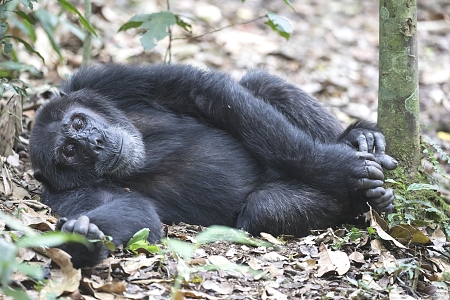
The main attractions in Nyungwe are the large troops of Ruwenzori
colobus monkeys, and chimp tracking. Guides lead you through the
forest in search of these elusive beasts. I saw three high in the
canopy during a three-hour walk, but it was worth it to be in the
forest, and sightings can be a lot better. We also had good
sightings of grey-cheeked mangabey monkeys and l’Hoest’s. The
national park has just been gazetted – and not a moment too soon! -
to save this forest from the depredations of agriculture. Fields of
maize, beans and bananas are intensively cultivated right up to the
forest's edge.
Day 3:
Day for going chimpanzee tracking and for guided forest walks.
Day 4:
A long and very scenic drive (about 5 hours) on unmade roads to
Kibuye,on the shores of Lake Kivu. Stay overnight at Kibuye Guest
House. If you get there in good time, you can take a boat out on the
lake.
Longish drives on un-made roads may not appeal to everyone, but they
do offer the opportunity to see life as it has been lived for
centuries, virtually unchanged. This is a very scenic route and
provides the opportunity to see the people at work – cultivating
bananas, cassava, sorghum, beans, rice, potatoes, and even coffee in
their steep and tiny fields. In addition, there are several massive
tea plantations, villages, innumerable tiny brickworks, and
surprises around every corner.
Lake Kivu forms the border between Rwanda and the Congo. It’s a
beautiful and mysterious lake, always alive with traders and
fishermen in their dugout canoes.
Day 5-6:
Today you head north-east, parallel to Lake Kivu, to Gisenyi to stay
two nights at the Kivu Sun on half-board.
This beautiful drive (3–4 hours) is largely on unmade road and takes
you through an area of intensive subsistence farming, as well as the
remains of the Gishwati Forest.
Gisenyi is a somewhat faded lakeside resort - and also a border
crossing point into the Congo. The shoreside is lined with crumbling
colonial villas. Today, it is enjoying a renaissance as it boasts
its first international standard hotel - the newly-opened Kivu Sun.
It is a pleasant hotel, right on the lakeside, with its own private
pool.
There is plenty to see and do here: take a boat on the beautiful
lake; visit the Imbabazi Orphanage where you can still find the
founder, glamorous Rosamund Carr, now in her late 80s; take a drive
into the ancient Gishwati Forest; or, when the border is open, cross
into the Congo to visit Gomo, site of the volcanic eruption two
years ago.
Day 7:
Make an early start for the 2-hour drive to Kinigi at the Parc
National des Volcans for the first gorilla trek. On arrival at
07h00, staff from ORTPN Park Headquarters who brief you on conduct
during gorilla tracking meets you. The trackers then lead you into
the forested slopes to seek one of the groups of Mountain Gorillas.
Reaching the gorillas can be quick, or it can take a few hours.
Return for lunch at the Mountain Gorillas Nest Lodge where you
overnight, all meals included. In the afternoon, visit the panoramic
twin volcanic lakes of Burera and Ruhondo.
Mountain Gorillas Nest Lodge is a reasonably modern lodge of fifty
rooms in double chalets grouped around a central garden area in a
nice wooded location. Rooms are variable. Comfortable but smallish,
apart from the two VIP rooms, they sometimes experience plumbing
problems and the hotel is prone to occasional power cuts. There is a
lively restaurant and bar, the food is variable but can be good
here. The lodge is right by the trailhead for gorilla trekking.
PNV Volcanoes Lodge is the alternative, an upmarket lodge built in a
stunning position atop a hillside with a splendid view over the twin
volcano lakes, and, on a clear day, of the whole chain of volcanoes
in the national park. Visibility is best in the rainy season
(November short rains), otherwise the mountains can be obscured by
haze. The comfortable brick chalets employ advanced, environmentally
sound technology. It is really the best accommodation in Rwanda but
it has three drawbacks: it is expensive, compared with Gorillas
Nest; it is high up at 2200 metres and quite exposed; and it takes
an hour to drive to the gorilla trail head from the lodge.
Day 8:
You have your second Gorilla tracking today. If you are reasonably
fit, we recommend the Susa group for the second expedition. In the
afternoon, you are driven to Kigali (2½ hours) to stay overnight in
Hotel Milles Collines, breakfast included.
Day 09:
Today you could visit to the Genocide Memorial Museum before you
transfer to the airport for your flight to Nairobi, where you
connect with your onward flight back home.
END OF THE TOUR
|